
Design Principles, Market Analysis & Technical Requirements — The PRD Sections That Make or Break Your MVP
You wrote the PRD. Now make it actually useful — to your developers, your investors, and every other tool in your stack.

Two weeks ago, we laid out the MVP crisis — why most startups burn through their runway before they ever reach a customer. Last week, we broke down the PRD: what it is, why it matters, and why building without one is the most expensive mistake a founder can make.
If you followed the advice, you now have a PRD. Problem statement. Solution overview. User flows. Phased feature roadmap. You’re ahead of 90% of founders.
But here’s what nobody tells you: a PRD with those sections alone is a skeleton. It can hold shape. It can’t move. The sections that give a PRD its muscle — the ones that turn it from a planning document into a strategic asset — are the ones most founders either skip entirely or fill with guesswork.
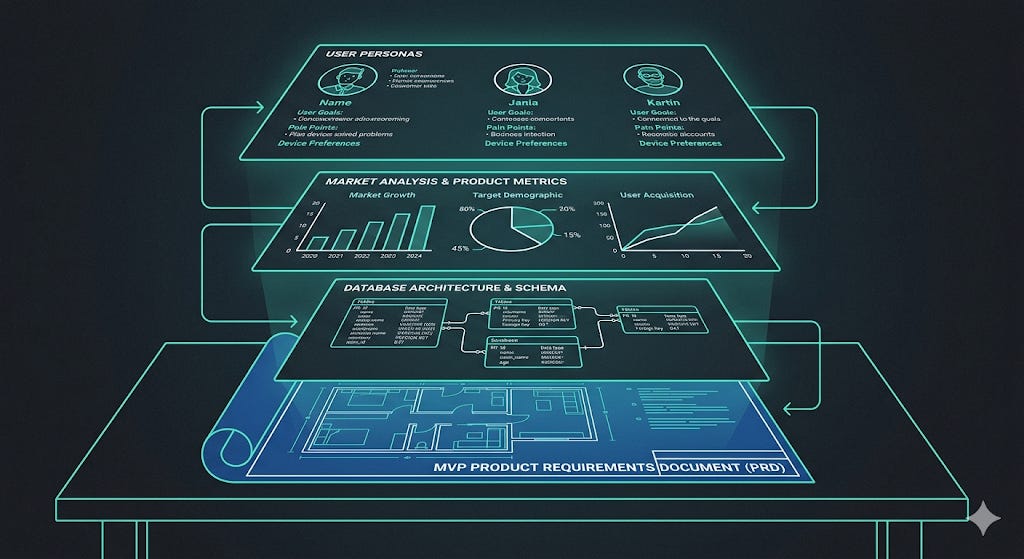
This week, we’re going deep on three of those sections: Design Principles, Market Analysis, and Technical Requirements. These are the layers that connect your product vision to your actual users, your actual market, and your actual codebase. Get them right, and your PRD becomes the single source of truth for everything — development sprints, investor conversations, pitch decks, even your go-to-market strategy. Get them wrong, and you’re building a product for an audience you’ve imagined, in a market you haven’t sized, on architecture that won’t scale past your demo.
Let’s fix that.
Design Principles: You Don’t Know Your User As Well As You Think
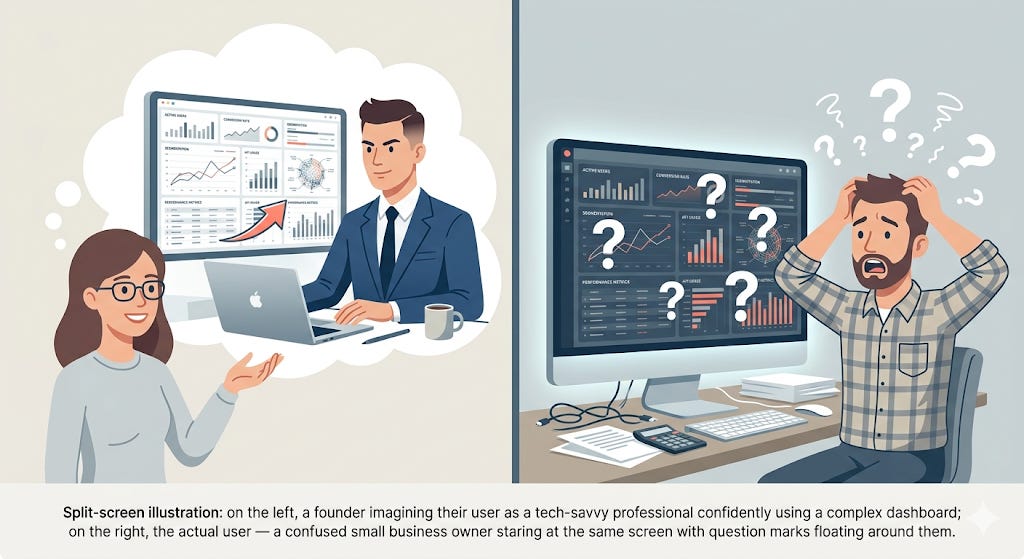
Every founder has a mental image of their user. They can describe them in detail — the frustrated freelancer, the overwhelmed small business owner, the first-time manager drowning in spreadsheets. The description feels vivid. It feels specific. And in almost every case, it’s wrong.
Not completely wrong. Wrong in the ways that matter. The founder imagines a user who thinks the way the founder thinks, values what the founder values, and navigates software the way the founder navigates software. This is the empathy gap that kills MVPs — not a lack of caring about users, but an unconscious assumption that your users are basically you with a different job title.
Design principles are the antidote. They formalize three things that most founders carry as vague intuitions and never pressure-test.
User Personas
A persona is not a marketing avatar. It’s not “Sarah, 32, loves yoga and drinks oat milk.” A useful persona captures behavior, not demographics. What does this person do when they encounter your problem today? What tools do they currently use? What’s the moment when they get frustrated enough to search for something new? And critically — what would make them abandon your product thirty seconds after signing up?
Alan Cooper’s About Face — the book that introduced personas to software design — makes the distinction between what users say they want and what their behavior reveals they need. A persona built on interviews where people told you “yeah, I’d definitely use that” is fiction. A persona built on watching someone spend forty-five minutes on a task your product could handle in three — that’s a foundation you can build on.
The problem is that building rigorous personas takes time. You need user interviews, behavioral data, and enough intellectual honesty to admit when your assumptions were wrong. Most founders skip the work because they’re racing toward code. They tell themselves they’ll “figure out the user later.” Later never comes. By the time the product ships, the user model is whatever the founder assumed on day one, and the product’s UX reflects every blind spot in that assumption.
User Journeys
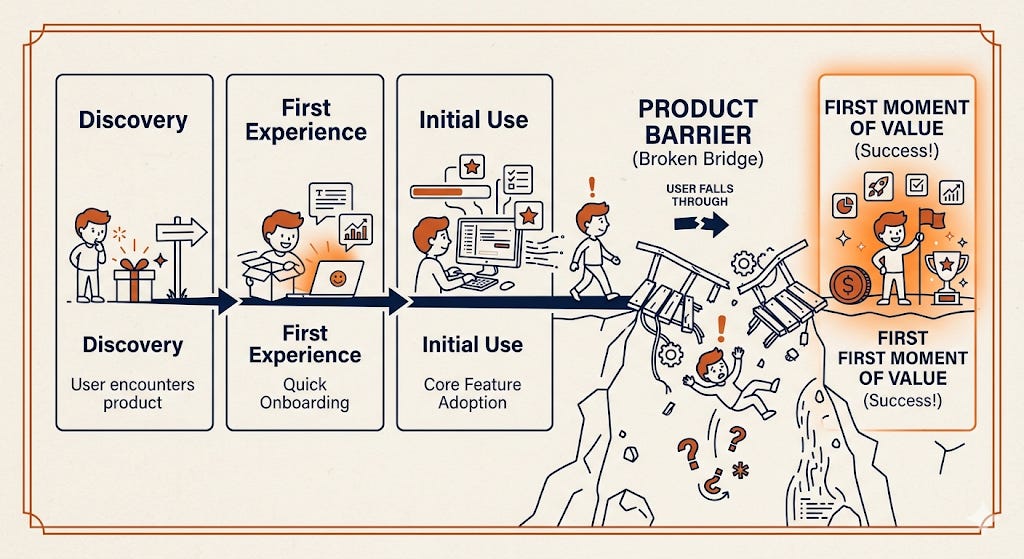
A persona tells you who your user is. A user journey tells you what their experience actually looks like, end to end — not just inside your product, but before and after. Where does the user hear about you? What’s their emotional state when they arrive? What’s the first thing they see, and does it match the expectation that brought them there?
This is where most MVPs silently fail. The product works — technically. Features function. Buttons click. But the journey is incoherent. The onboarding assumes knowledge the user doesn’t have. The core action is buried behind three screens that made sense to the developer but make no sense to a first-time user. The “success” moment — the point where the user gets value — happens too late, or isn’t visible enough, or doesn’t feel like success at all.
Kim Goodwin’s Designing for the Digital Age walks through journey mapping in depth — how to identify the touchpoints, transitions, and emotional arcs that determine whether a user converts or bounces. The key insight is that users don’t evaluate features in isolation. They evaluate flows. A product with ten great features and a broken journey between them will lose to a product with three decent features and a seamless path from signup to value.
Sitemaps and Navigation Patterns
Once you know who your user is and what their journey looks like, you need to organize your product so the journey actually works. A sitemap isn’t a technical artifact. It’s a decision about priority — what’s one click away, what’s two clicks away, and what’s buried in a settings menu the user will never find.
The Information Architecture Institute has published extensively on why navigation patterns matter more than individual page designs. Users don’t read your interface. They scan for the next logical action. If your navigation doesn’t match their mental model of what comes next, they stall. And stalled users don’t file bug reports. They leave.
Here’s what makes this concrete. Take Botnim — an Israeli startup that built an AI-powered chatbot platform for small businesses. Technically capable product. Real market need. But their initial MVP assumed their users — small business owners — would be comfortable configuring conversation flows through a node-based visual editor. The kind of interface a developer finds intuitive. Their actual users wanted to type a few sentences describing what they needed and have the system handle the rest. The user persona was “small business owner.” The product was designed for “small business owner who thinks like a developer.” That gap cost months of rework.
Auto-generated personas force you to confront these gaps before they cost you anything. When a system generates personas from your product description and maps them against real behavioral patterns, it surfaces the assumptions you didn’t know you were making. “Your target user has low technical confidence” is an uncomfortable insight at the PRD stage. At the post-launch stage, it’s a catastrophe.
Market Analysis: The Section Your Investors Will Read First
Here’s something founders learn the hard way: investors don’t read your PRD front to back. They skip to three things — the problem statement, the market analysis, and the competitive landscape. If those are thin, the conversation is over before it starts.
Market analysis in a PRD isn’t the same as market analysis in a pitch deck. A pitch deck’s job is to persuade. A PRD’s job is to be accurate. The market analysis in your PRD should be the honest version — the one that tells you whether the market is real, not the one that tells investors the market is huge.
TAM, SAM, SOM
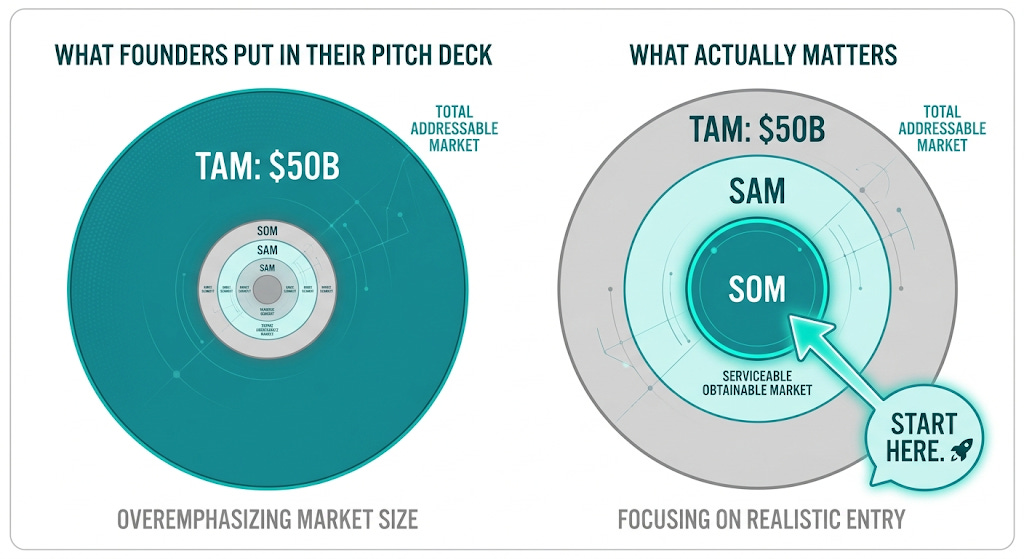
Total Addressable Market, Serviceable Addressable Market, Serviceable Obtainable Market. You’ve seen these numbers in every pitch deck you’ve ever read. Most of them are fiction. A founder googles the size of their industry, slaps a big number on a slide, and calls it TAM. That’s not market analysis. That’s wishful arithmetic.
Real TAM/SAM/SOM analysis starts from the bottom, not the top. How many people have the specific problem you’re solving? How many of them are reachable through the channels you have access to? How many of those would realistically pay for a solution in the next twelve months? The bottom-up approach almost always produces a smaller number than the top-down approach. That smaller number is the one that’s actually useful, because it’s the one you can test.
Bill Aulet’s Disciplined Entrepreneurship from MIT walks through this methodology in detail — twenty-four steps from market segmentation to quantified value proposition. The insight that matters most for PRD purposes is this: your market size should constrain your feature set. If your obtainable market is 5,000 users in year one, you don’t need infrastructure that scales to a million. You need infrastructure that delights 5,000 people enough that they tell others.
Competitive Context
Every product exists in a competitive landscape, even if the founder believes they have no competitors. If no one else is solving this problem, that’s not a blue ocean — it’s a red flag. Either the problem isn’t painful enough to pay for, or you haven’t looked hard enough.
A competitive analysis in a PRD should answer three questions. What exists today that addresses even part of the same problem? Where are those solutions weak — not in your opinion, but in the words of their users? And what is your specific structural advantage — not “better UX” or “AI-powered,” but the concrete reason your approach will win a user who is currently using something else?
April Dunford’s Obviously Awesome reframes competitive analysis as positioning — understanding not just who you’re competing against, but what category your product belongs in and how that category shapes user expectations. If your users think of your product as “a better Trello,” they’ll expect Trello-like features. If they think of it as “an AI project manager,” they’ll expect something fundamentally different. Your PRD’s competitive analysis should make your positioning explicit, because your positioning determines what features are table stakes and what features are differentiators.
Market Assumptions
This is the section nobody writes but everybody should. What are you assuming about the market that, if wrong, would invalidate your entire product? “We assume freelance designers currently track invoices manually.” “We assume small businesses will pay $29/month for this.” “We assume our target user checks this type of tool at least weekly.” Write them down. Each assumption is a hypothesis that your MVP is designed to test. If your PRD doesn’t list your market assumptions, your MVP isn’t testing anything — it’s just a product you hope people will use.
Technical Requirements: The Layer That Saves You From Your Own Architecture
This is where most non-technical founders check out. Database schemas. Entity-relationship diagrams. API specifications. It sounds like developer territory — and it is. But the decisions made in this layer determine whether your product can actually do what your user stories promise, and whether adding features in Phase 2 will take two weeks or two months.
The technical requirements section of a PRD doesn’t need to be written by a developer. It needs to be understood by the founder. Because when your developer tells you “that feature requires a database migration and we need to restructure the user model,” what they’re really saying is “a decision we made early on didn’t account for this, and now fixing it is expensive.” The technical requirements section is where those early decisions get made intentionally rather than accidentally.
Architecture Documents
At the PRD level, an architecture document isn’t a detailed system design. It’s a high-level map of the major components: front end, back end, database, third-party services, authentication. What talks to what. Where the data lives. How the user’s actions in the interface translate to operations in the system.
Martin Fowler’s Patterns of Enterprise Application Architecture remains the reference text for thinking about these decisions at the right altitude — high enough to guide development, detailed enough to prevent the structural mistakes that require rewrites. The key question the architecture document should answer is: “Does this structure support all of the user flows in the PRD?” If your PRD includes a user flow where a client receives an invoice via email, your architecture needs an email service. Obvious in hindsight. Frequently missed in practice.
Data Models and ERD Diagrams
An entity-relationship diagram maps the objects in your system and how they connect. Users, invoices, clients, payments — these are entities. “A user creates many invoices,” “an invoice belongs to one client,” “a payment is linked to one invoice” — these are relationships. The ERD makes them visual and explicit.
Why does this matter in a PRD? Because your data model constrains what features are possible. If your data model doesn’t include a relationship between invoices and recurring schedules, you can’t build recurring invoicing without restructuring the database. If your user entity doesn’t have a “team” relationship, you can’t add team features later without a migration. These constraints are invisible in a feature list. They’re obvious in an ERD.
Sample Data Tables
This is a small addition that pays for itself immediately. Take your ERD and populate it with example data. Three sample users. Five sample invoices. Two sample clients. Suddenly, abstract relationships become concrete. You can look at the data and ask: “If Client A has two unpaid invoices totaling $3,000, and User B sends a reminder, what exactly does the system need to query?” These questions surface edge cases, missing fields, and broken assumptions faster than any amount of abstract discussion.
Your PRD Is Not Just for Development — It’s a Cross-Platform Asset
Here’s something founders almost never realize until it’s too late: the sections of your PRD aren’t just instructions for developers. They’re the raw material for nearly everything else your startup needs to produce.
Your market analysis — the TAM/SAM/SOM numbers, the competitive landscape, the positioning — that’s your investor pitch, structured and quantified. Your personas and user journeys — those feed directly into your marketing messaging, your onboarding copy, your sales scripts. Your phasing strategy — that’s your product roadmap slide, already built.
The problem has always been that these outputs live in different tools. Your PRD sits in one place. Your pitch deck lives in Gamma or Google Slides. Your project tickets are in Linear. Your marketing briefs are in Notion. You end up manually copying, reformatting, and inevitably losing consistency between them.
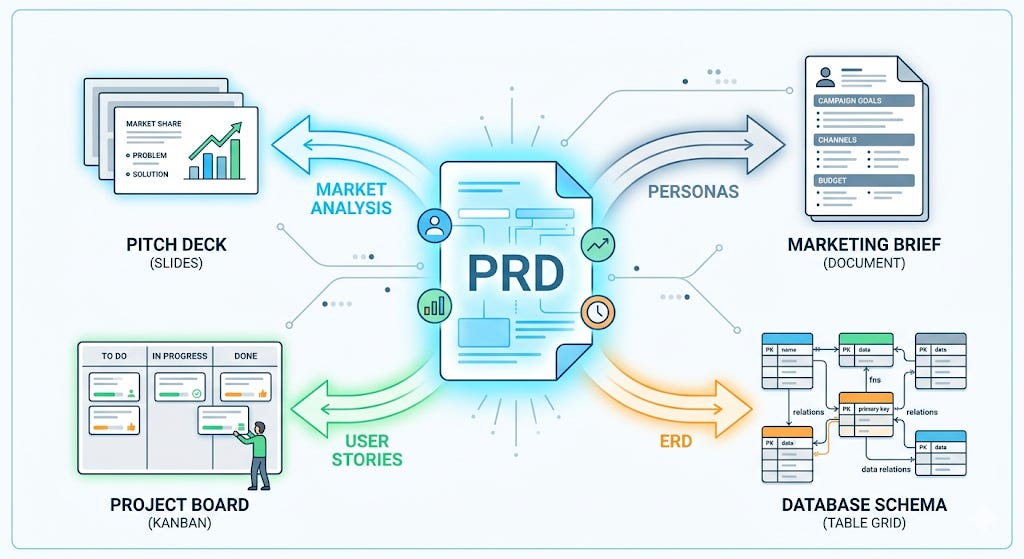
This is where the export layer becomes critical. When your PRD is structured — really structured, not just a document with headers — it can feed other tools directly. Take your business requirements and market analysis sections, export them into Gamma, and you have the foundation of an investor-ready pitch deck without starting from a blank slide. Push your user stories and acceptance criteria into Linear or Jira, and your sprint planning starts pre-loaded with validated tickets rather than tasks someone remembered from a Slack conversation.
Notion’s team has written extensively about using structured documents as single sources of truth across tools. Coda’s approach to connected docs makes a similar case — that documents should push data to other systems, not just hold it. The principle isn’t new. But most PRD tools treat the document as a terminal artifact — something you write, share, and never connect to anything downstream.
Codalio’s PRD is designed to be the opposite of terminal. Because every section is structured data — not just formatted text — it can flow into whatever your startup needs next. Pitch deck tool needs market sizing and competitive positioning? It’s already structured for export. Project management tool needs user stories with acceptance criteria? They’re already scoped and prioritized. Database tool needs a schema? It’s already modeled.
The point isn’t to replace Gamma, Linear, Notion, or any other tool in your stack. Those tools are excellent at what they do. The point is that what they do starts with structured inputs — and most founders create those inputs manually, inconsistently, and redundantly. A PRD that doubles as a source of truth for your entire tool chain doesn’t just save time on planning. It saves time on everything that comes after planning.
What Codalio Actually Does With These Sections
We’ve been abstract enough. Let’s get concrete.
When you describe your product to Codalio — in plain language, the way you’d explain it to a friend — the system doesn’t just generate a feature list and call it a PRD. It generates each of the layers we’ve discussed in this post, and it generates them as a connected system.
Personas aren’t generic templates. They’re derived from your specific product description, mapped against behavi
oral patterns, and pressure-tested against your user flows. If your persona says “low technical confidence” and your user flow requires configuring API keys, the system flags the contradiction.
Market analysis isn’t a blank section with “insert your TAM here.” The system generates TAM/SAM/SOM estimates based on your target market description, surfaces relevant competitive context, and — crucially — lists the market assumptions your MVP needs to validate. You can challenge every number, adjust every assumption, and watch the downstream implications update in real time.
Technical architecture isn’t an afterthought. The ERD is generated from your user stories. The data model reflects your actual feature set. Sample data tables are populated so you can see, concretely, what your database will hold. And when you change a user story — when you move a feature from Phase 1 to Phase 2, or add a new entity — the architecture adjusts.
Every section is connected. Change the persona, and the user journey updates. Change the user journey, and the feature set reflects it. Change the feature set, and the database schema follows. This is what it means to have a PRD that’s a system rather than a document.
And because the PRD is structured data, not a static file, it doesn’t just drive your development. It feeds your pitch deck. It populates your project management tool. It gives your entire startup a single, validated source of truth that every other tool in your stack can build from.
The Playbook, Updated
Three weeks in, the playbook is getting clearer.
Week 1: Understand the MVP crisis. Speed matters, but speed without structure kills you faster than slowness does.
Week 2: Write the PRD. Problem statement, solution overview, user flows, phased features. This is the foundation.
Week 3 — this week: Build the layers that make the PRD actually useful. Personas grounded in behavior, not assumptions. Market analysis that constrains your decisions instead of inflating your ego. Technical architecture that supports your user stories instead of surprising you six weeks into development.
Each layer makes the next one stronger. Personas inform user flows. User flows inform features. Features inform architecture. Architecture constrains what’s buildable in each phase. And market analysis tells you whether any of it matters.
Skip a layer, and the ones above it are guesswork. Build them all, and you have something most startups never achieve: a plan that holds together under the pressure of actually building software.
What’s Next
Next week, we go into the execution layer — how this validated PRD becomes running software. The AI agents, the code generation pipeline, the testing frameworks, and why the gap between “documented” and “deployed” is where most MVPs go to die.
In the meantime, if your PRD is a Google Doc with headers you haven’t updated since you wrote them, if your personas are a paragraph you improvised during a pitch, if your market analysis is a TAM number you pulled from a Statista report — you now know what’s missing.
Stop planning in fragments. Sign up for Codalio and auto-generate personas, market sizing, competitive analysis, and technical architecture — all from one platform, all connected, all exportable to the tools you already use.
Resources
About Face by Alan Cooper The foundational text on interaction design and goal-directed personas. Essential for understanding why demographic personas fail and behavioral personas work.
Designing for the Digital Age by Kim Goodwin Comprehensive guide to user journey mapping, interaction design, and translating research into product decisions.
Disciplined Entrepreneurship by Bill Aulet — MIT Twenty-four steps from idea to viable business, with rigorous frameworks for bottom-up market sizing.
Obviously Awesome by April Dunford The definitive guide to product positioning — understanding your competitive context and owning a category.
Patterns of Enterprise Application Architecture by Martin Fowler Reference for thinking about system architecture at the right altitude for product planning.
The Mom Test by Rob Fitzpatrick How to validate your assumptions through customer conversations that surface truth instead of politeness.
Gamma AI-powered presentation tool — a natural destination for exporting your PRD’s market analysis and business requirements into investor-ready pitch decks.
Notion Connected workspace for docs, projects, and knowledge management. Useful downstream from a structured PRD.
Linear Modern project management built for product teams. User stories and acceptance criteria from your PRD translate directly into sprint-ready issues.
Learned something valuable? We break down these patterns every week in Codalio’s newsletter. Subscribe to catch the common mistakes founders make — and learn how to avoid them.