
Codalio, Lovable or Bolt? The Real Differences in AI Driven Development Explored

Overview
AI app builders such as Lovable and Bolt have changed what “day zero” looks like for software. In a single afternoon, a founder can go from idea to a polished interface, working flows, and even a deployed demo that feels uncannily close to a real product. That speed is a genuine breakthrough: for validating ideas, pitching investors, building internal tools, or shipping personal side projects, these platforms are already good enough to feel transformative.
But this is precisely where confusion starts. The same tools that make you feel like a 10x engineer on day one are, as they exist today, still optimized for prototypes, not for the messy, unglamorous realities of production‑grade software. Once you want to support tens of thousands of users, strict SLAs, regulated industries, or a product with a multi‑year roadmap, you run into the limits of opaque AI agents, young ecosystems, and backends you don’t fully control.
Multiple experienced builders and reviewers on Substack and LinkedIn echo this pattern: Lovable and Bolt are incredible accelerators and “starter kits”, but serious teams often export the code to conventional stacks, pair them with tools like Cursor/Windsurf, or rebuild critical paths in mature frameworks to regain observability, testability, and scalability. Articles comparing v0, Bolt, and Lovable describe them as ideal for rapid prototyping and design‑led experimentation, while also warning that complex workflows, compliance requirements, and long‑term maintenance still demand traditional engineering depth.
This post takes that reality seriously. It does not argue that Lovable or Bolt are “toys”—they are already reshaping how products are conceived and iterated. Instead, it separates the hype from the hard requirements of scalable, reliable, high‑quality systems: clear domain models, explicit business logic, durable data architectures, and codebases that real teams can own, reason about, and extend for years. The goal is simple: if you are choosing between Codalio, Lovable, or Bolt for your next product, you should understand not just how fast you can ship a demo, but how confidently you can still operate, evolve, and scale that software when there are hundreds, thousands, or millions of users on the other side of the screen.
1. Deliverables: Prototype Appearance vs. Fully Developed System
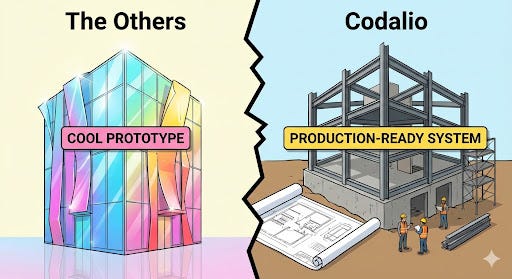
When generating software from a prompt, many AI tools produce a polished visual prototype. These outputs primarily consist of frontend code like HTML and CSS, designed to look like a complete application. However, this code often lacks the structure and maintainability required for long-term development. They are optimized for prototyping and early validation, not yet battle‑tested for complex, high‑scale production environments.
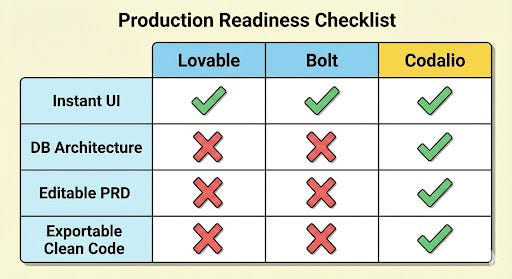
Alternatively, some platforms focus on delivering comprehensive development artifacts. These include detailed specifications such as project requirements, data models, API definitions, and infrastructure configurations. This approach provides a foundation suitable for a team to continue building a robust product rather than just a visual mockup.
2. Maintaining Consistency: Managing Requirements and Code
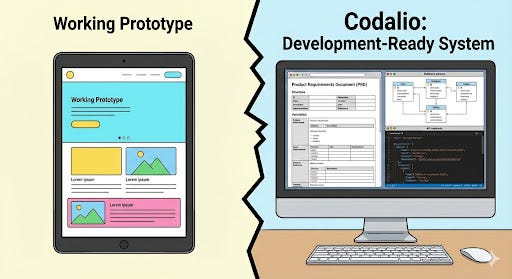
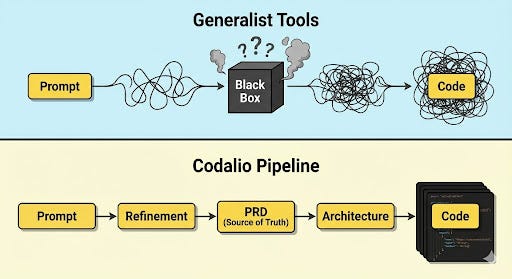
Typical AI-driven development tools translate user input directly into code. Changes in requirements generally require re-entering prompts, which can lead to inconsistent or unpredictable results. This poses challenges in maintaining alignment between the desired product and the actual software.
A more reliable method treats the project documentation as the definitive source. Updates occur first in a structured requirements document, which then systematically update the underlying code. This process ensures the codebase remains consistent with specifications, preventing divergence between design intentions and implementation.
3. Understanding Software Structure
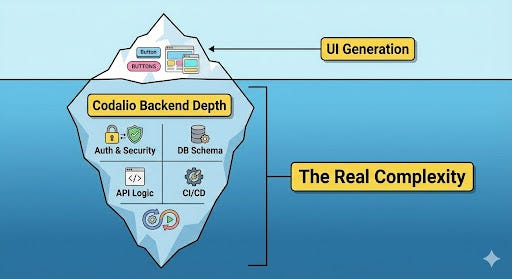
Simple UI elements can be quickly generated by many AI tools through assembling pre-existing templates. However, creating complex backend functions—such as secure authentication, user roles, and asynchronous processing—demands a deeper understanding of system architecture.
Platforms with architectural awareness build on proven frameworks that handle backend complexity out of the box. Such tools produce code that goes beyond surface-level UI, incorporating essential backend logic and security features, enabling scalable and maintainable systems.
4. User Interface Capabilities vs. Backend Robustness
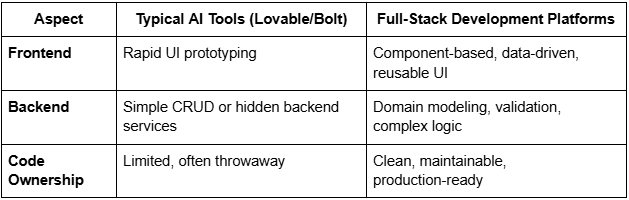
AI tools excel at quickly generating frontend user interfaces, making them valuable for visualizing ideas or creating early-stage demos. However, these interfaces often require manual rewriting to support advanced behaviors or integrations.
On the backend, many solutions offer only basic data operations or connect to external backend services that obscure the underlying logic. In contrast, platforms emphasizing backend depth provide fully developed domain models, comprehensive data management, and clear business rule implementation in code that developers can own and extend.
5. Readiness for Production Use
Rapidly assembled projects work well as demonstrations but often lack the robustness required in real-world applications. Handling failure scenarios, ensuring security, and managing multiple deployment environments are frequently absent from quick prototypes.
Systems designed for production include built-in authentication, secure protocols, environment separation (development, staging, production), and automated deployment pipelines. These features prepare an application to reliably support real users and business requirements beyond initial development.
6. Suitability for Different User Types
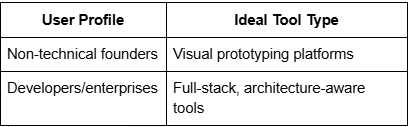
AI prototyping platforms commonly cater to non-technical users such as designers or founders who need to explore or showcase ideas without coding skills. These tools provide fast, easy access to visual outputs but usually require redevelopment for actual product use.
On the other hand, platforms designed for technical users support developers and hybrid founders aiming to build maintainable products. They offer a balance between automation and manual control, producing artifacts that can be transitioned into full development teams and ongoing maintenance without losing structural integrity.
When to use what
Choosing between Codalio, Lovable, and Bolt is less about which tool is “best” and more about what stage you are in and how far you expect the product to go. The matrix below gives a clear rule of thumb for most founders and product teams.eesel+8
Use Lovable when…
You need a working UI and flows this week to validate an idea, show investors, or collect early user feedback.bolt+2
You are building simple CRUD apps, internal dashboards, or lightweight client projects where long‑term scale and deep customization are not the main concern.dronahq+2
You are comfortable treating the generated code as a starter that might later be exported and rebuilt in a more controlled stack once the idea proves itself.uibakery+3
Use Bolt when…
You want fast, clickable, live prototypes that convey complex flows better than static design files.amankhan1.substack+3
You are a product or engineering team that intends to use Bolt for boilerplate and exploration, then have developers take over to harden architecture, testing, and deployment.refine+3
You are comfortable with some AI‑driven “magic” during the prototyping phase but plan to regain strict control over code and infrastructure before serious scale.builder+3
Use Codalio when…
You are building an MVP that you expect to become a real, long‑lived product with thousands or millions of users, not just a demo.decklaration+3
You want production‑ready, maintainable code in mature frameworks (e.g., Rails/React via Rhino) with a clear domain model, modular backend, and a scaling path baked in from day one.codalio+3
You care about observability, testability, security, and the ability for an engineering team to own, extend, and refactor the codebase over years without fighting a black‑box platform.dev+3
Simple rule of thumb
If the main question is “Can we see and click something this week?”, start with Lovable or Bolt.vanquicktech+3
If the main question is “Can this support real users, real data, and real growth for the next 3–5 years?”, start with Codalio.codalio+3
Conclusion
Modern AI builders have made it possible to go from idea to interactive prototype in a single sitting, but that doesn’t change what it takes to run a real product in production. Lovable and Bolt are fantastic when the goal is speed, exploration, and fast feedback loops; they are not yet a replacement for the engineering depth, explicit architecture, and durable codebases needed to support real users at scale over years. The teams that win will be the ones that use these tools for what they do best—rapid prototyping—while choosing a foundation designed for reliability, observability, and growth once the stakes get real.
If you are at the point where a quick demo is not enough, it is time to treat your next build as the first iteration of a long‑lived product rather than a throwaway prototype. Codalio is designed precisely for that moment: generating real, clean, framework‑based code with a clear domain model and a path to scale, instead of locking you into a fragile prototype.
Head over to Codalio.com to create a free Product Requirements document and detailed technical scope tailored to your idea. This will give you a concrete, engineering‑ready view of your product—features, architecture, and implementation detail—so you can move from “cool AI demo” to a production‑ready MVP with confidence.
References:
“AI‑Driven Prototyping: v0, Bolt, and Lovable Compared” – positions these tools as rapid prototyping environments and discusses where they shine.
“AI Development Tools in 2024” by Daniel Pleus – compares Lovable, Bolt, and others in real dev workflows.
“Comparing AI Code‑Gen Tools: A Personal Journey” – anecdotal but concrete evaluation of Replit, Lovable, Bolt.
“How AI Prototyping Tools Actually Work: A Deep Dive into Bolt” – explicitly frames Bolt as a prototyping layer over LLMs.
“Built with Bolt.new? Here’s How to Scale Your Prototype for Production” (ShipAI blog, widely shared on LinkedIn/X) – argues Bolt is excellent for prototypes but needs extra engineering for production deployment and scaling.
“An honest look at Lovable” (eesel.ai blog) – highlights Lovable’s power but also issues around reliability, scaling and complex logic.
“What is Lovable AI? A Deep Dive into the Builder” (UIBakery) – calls Lovable more of a starter kit and details ecosystem and scaling limitations.