
Backend Code Generation with Rhino — Why Real Code Beats No-Code for Scalable SaaS MVPs

There’s a moment every founder hits, usually around month three, when the no-code tool they chose to “move fast” becomes the reason they’ve stopped moving at all.
The workflow they built in a weekend starts hitting walls. Custom logic doesn’t fit the drag-and-drop model. The API integration they need isn’t supported. Scaling past a few hundred users exposes architecture decisions baked into the platform — decisions they never made and can’t change. And the developer they finally bring in to fix it takes one look at the underlying structure and tells them what they didn’t want to hear: we’re rebuilding this from scratch.
This is the no-code trap. And it’s entirely avoidable — if you start with real code.
This week, we’re going deep on Rhino, Codalio’s backend code generation engine. How it works, what it produces, and why the choice of Ruby on Rails as its foundation isn’t just a technical preference — it’s a strategic one.
Why Ruby on Rails for MVPs
Every tech stack debate eventually comes down to the same question: what are you optimizing for?
For a consumer SaaS startup raising a seed round, you’re optimizing for speed-to-validation, code quality you can build on, and infrastructure you can hand to an engineering team without a rewrite. Ruby on Rails has been the answer to that question for twenty years — and the reasoning hasn’t changed.
Convention over configuration. Rails makes decisions for you. Where files live, how models connect to the database, how routing works, how authentication gets implemented. These aren’t limitations — they’re eliminated decisions. Every decision you don’t have to make is a week you don’t waste debating it.
Battle-tested at scale. GitHub, Shopify, Airbnb, Stripe — they all started on Rails. The framework’s maturity means that every pattern you need for a SaaS product has been solved, documented, and stress-tested in production. You’re not pioneering. You’re inheriting.
Fast developer onboarding. When your product gets traction and you hire your first engineers, a Rails codebase is a known quantity. There’s a massive talent pool, clear conventions to orient against, and an ecosystem of gems that handle everything from background jobs to file storage. Your new hires can be productive in days, not months.
This is why Rhino generates Rails. Not because it’s the only answer — it’s because for an MVP that needs to ship, validate, and scale, it’s consistently the right one.
Specification-Driven Development: The End of the Agile vs. Waterfall Debate
Before we get into what Rhino generates, let’s talk about how it generates it — because the methodology matters as much as the output.
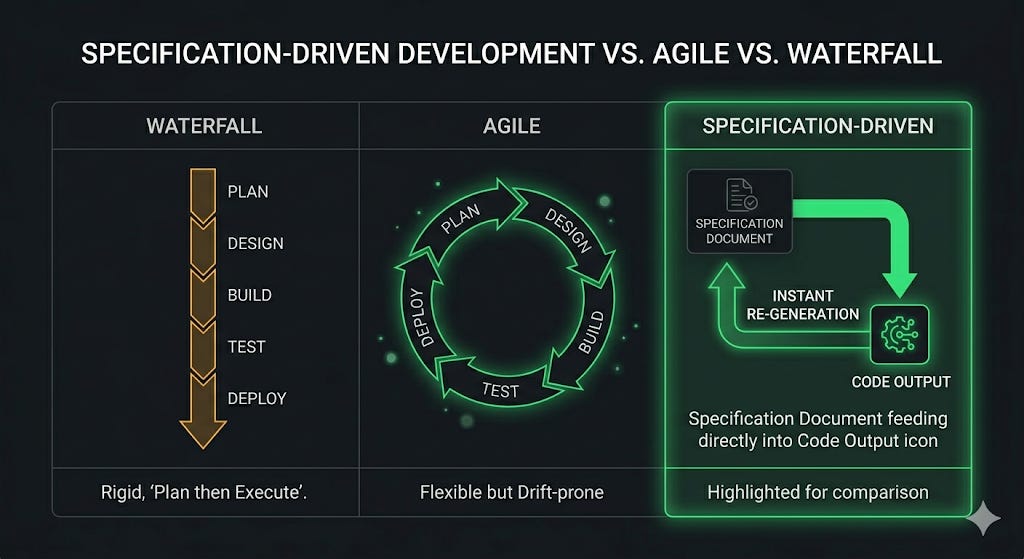
The debate between Agile and Waterfall has been running in software development circles for decades. Waterfall teams front-load planning and struggle to adapt when reality diverges from the plan. Agile teams stay flexible but can drift without a structural north star, racking up scope creep and direction changes that erode timelines and burn out teams.
Rhino sidesteps both problems through specification-driven development.
Here’s the idea: instead of starting with a sprint plan or a Gantt chart, you start with a complete, machine-readable specification of what you’re building. Your ERD (Entity Relationship Diagram). Your API contracts. Your authentication model. Your data validation rules. The spec is the source of truth — and the code is generated from it.
When requirements change — and they will — you update the spec, not the codebase. Rhino re-generates. Instantly. No team sync required. No sprint replanning. No two-week cycle to see the impact of a single change. The iteration loop that used to take weeks collapses into hours.
This isn’t Agile. This isn’t Waterfall. It’s something better: a process where the rigor of planning and the speed of iteration aren’t in tension, because the machine handles the translation between them.
What Rhino Actually Generates
Let’s get specific, because “code generation” is a phrase that means very different things depending on who’s saying it.
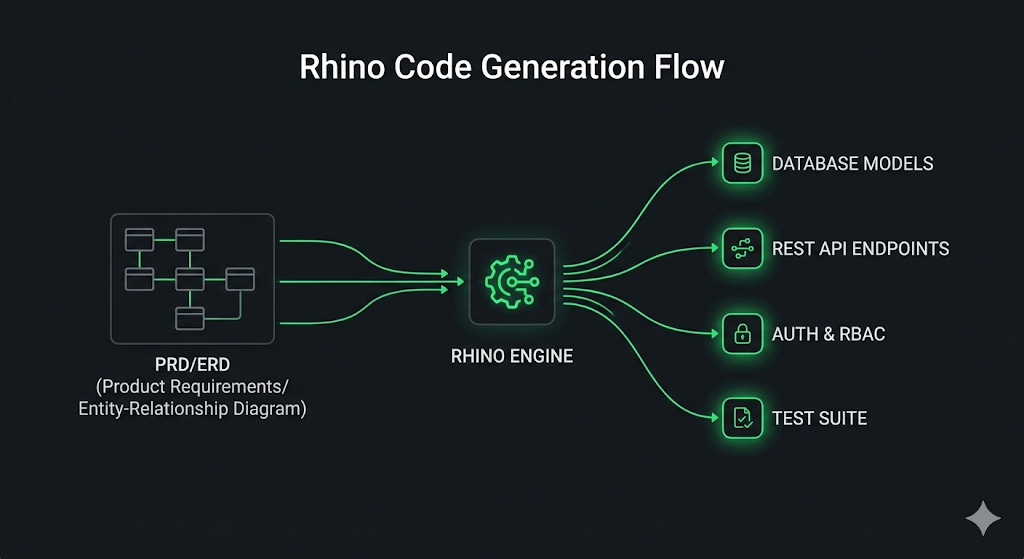
Rhino takes your Codalio PRD — your ERD, your user stories, your API requirements — and produces a complete Rails backend. Here’s what that includes.
Database models. Every entity in your ERD becomes an ActiveRecord model with the correct data types, validations, associations, and database migrations. You don’t write schema files. You don’t hand-code foreign key constraints. The data layer is generated from your diagram, consistently and correctly.
RESTful API endpoints. Every interaction in your user stories maps to an API endpoint. Rhino generates controllers, routes, serializers, and response formatting — following Rails conventions throughout. The API is documented, structured, and immediately testable.
Authentication and authorization. Role-based access control, session management, token authentication — generated based on the user personas and permission structures defined in your PRD. Not a generic auth template. Auth that reflects how your specific users interact with your specific product.
Business logic scaffolding. Service objects, background jobs, webhook handlers — the structural components your application logic will live in. The scaffolding follows Rails best practices so your team can fill in the product-specific logic without making architecture decisions from scratch.
Test suite foundations. RSpec test files for models, requests, and services. Not complete test coverage — that’s earned over time — but the structure that makes testing a natural part of the development workflow rather than a retrofit at the end.
What you get from Rhino isn’t a prototype. It’s a production-ready backend that a developer can deploy, test, and build on without a refactor sprint to clean up the scaffolding.
Real Code vs. No-Code: The Honest Comparison
No-code tools have earned their place. For internal tools, simple automations, landing pages, and early-stage concept validation, they’re genuinely useful. We’re not here to dismiss them.
But for a SaaS product that needs to grow, the tradeoffs are real and they compound over time.
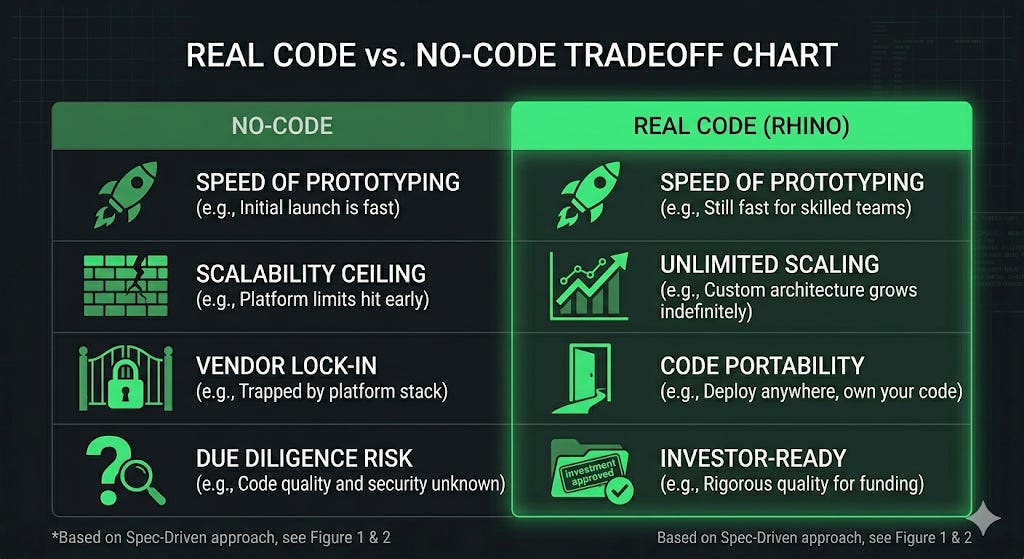
Scaling limits are structural, not fixable. No-code platforms make architectural decisions on your behalf — database structures, query patterns, caching strategies. When your product grows past the assumptions those decisions were built on, you hit a ceiling that isn’t a tuning problem. It’s a foundation problem.
Customization has a hard edge. The interaction pattern your product needs is either supported by the platform or it isn’t. When it isn’t, you build workarounds. Workarounds create technical debt. Technical debt creates the rewrite conversation.
Investor and acquirer confidence. This is rarely discussed openly, but it matters. Technical due diligence on a no-code backend raises flags that don’t exist with a conventional codebase. Investors and acquirers want to see something they can evaluate, extend, and hand to an engineering team. A proprietary no-code platform isn’t that.
Portability is zero. Your no-code application exists inside the platform. If that platform changes pricing, discontinues features, or shuts down, you have no exit. Your code is their code.
Rhino-generated Rails code is yours. It runs on your infrastructure. It’s readable by any Rails developer. It’s portable to any cloud provider. It doesn’t have a platform vendor between you and your product.
What Clients Are Seeing
The feedback from founders using Rhino has been consistent across two dimensions: the code is validated and the code is scalable.
Validated means it follows Rails conventions correctly enough that senior engineers reviewing it for the first time don’t find surprises. No idiosyncratic patterns. No anti-patterns baked in by the generation process. Code that reads like it was written by a developer who knows the framework.
Scalable means the architecture holds up under the kind of load that comes after traction. The database schema can be extended. The API layer can be versioned. The authentication model can accommodate new roles. The foundation doesn’t need to be replaced when the product starts working.
For founders who’ve been burned by early technical decisions before, that combination is what makes Rhino different from what they expected automated code generation to be.
Stop Debating Frameworks. Start Shipping.
The framework debate is a form of productive-feeling procrastination. Rails vs. Django vs. Node. SQL vs. NoSQL. REST vs. GraphQL. Founders spend weeks on these questions and emerge with opinions, not products.
Rhino makes the decision. Rails, because it’s the right tool for this job. And then it builds the backend — from your ERD to your API to your auth layer — in the time it used to take to schedule the kickoff meeting with your dev shop.
Your MVP doesn’t need a better framework debate. It needs a backend.
Sign up for Codalio → and let Rhino generate your production-ready Rails backend from your PRD — before you spend your first dollar on development.